
Why the 5% deposit is becoming a mortgage prison for Australian buyers
Low 5% deposits trap Australian buyers in high-LVR mortgages, costing $15,000+ extra in LMI. Find out why this is becoming a mortgage prison.
— Halo Editorial

Arrears for first home buyers hit double the rate of established owners in early 20261. This spike is driven by the combination of thin equity buffers and the cumulative impact of May 2026 RBA Rate Hike: Serviceability, Self-Employed Clients, and the Refinance Cliff on borrowers who entered the market with 5% deposits. Brokers must now weigh the immediate benefit of market entry against the long-term risk of a client becoming trapped in a high-rate mortgage they cannot refinance due to negative equity.
The arithmetic of a zero-margin loan
A 5% deposit is not a smaller version of a standard 20% deposit. It is a structurally different risk position. If a client buys a $850,000 property in Melbourne with a 5% deposit of $42,500, they start with a razor-thin margin. A modest 5% correction in local property prices completely wipes out their equity. This is not a theoretical stress test. It is the current reality for a significant cohort of borrowers who bought during the peak of the recent cycle.
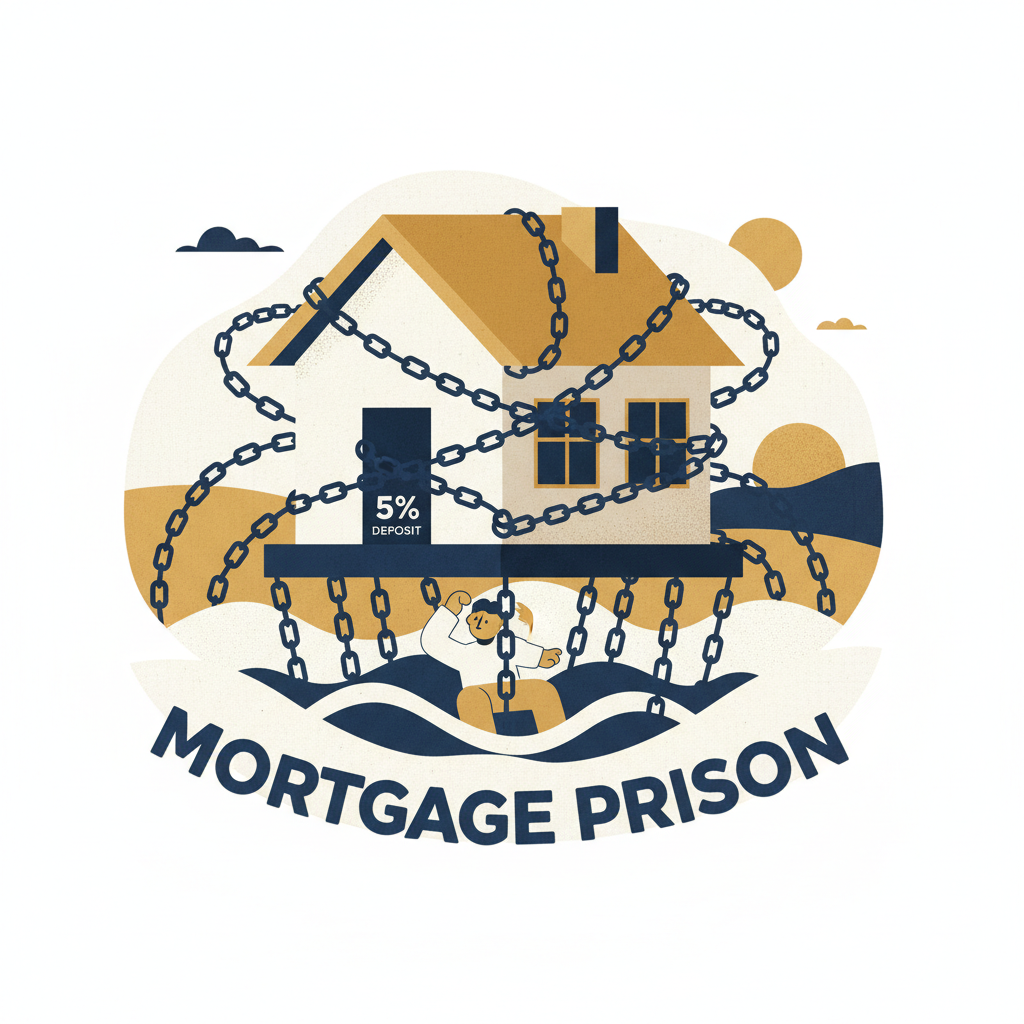
Established buyers with 30% or 40% equity can absorb a market dip and still refinance to a lower rate if their current lender gets greedy. The low-deposit borrower does not have that luxury. When their equity vanishes, they enter what the industry calls a mortgage prison. They are stuck with their current lender, paying whatever loyalty tax is applied, because they cannot meet the 80% loan-to-value ratio required to switch to a competitive deal. This lack of an exit strategy is what turns a temporary cash flow squeeze into a permanent financial crisis.
Consider the cash flow shift. A borrower who took out a $600,000 loan two years ago has seen their monthly repayments jump by roughly $1,400. For a single-income household earning $110,000, that is not a minor adjustment; it is an entire week of take-home pay gone. The AFR data confirming that arrears in this segment are double the market average suggests the breaking point has already been reached for many families1.
The quiet tightening of lender shade policies
Lenders rarely announce when they are getting nervous about first home buyers. They do not need to issue a press release to change their behaviour. Instead, they adjust their internal shade policies. They might increase the buffer they apply to discretionary spending or tighten the postcodes where they will accept a 95% loan. You might see a deal that would have been a straight-through approval six months ago suddenly come back with a request for more evidence of genuine savings or a lower debt-to-income cap.
On a household income of $130,000, a minor 0.5% tweak to a lender's assessment floor can wipe $40,000 off a client's borrowing capacity. This happens behind the scenes. The broker sees a decline or a lower-than-expected pre-approval without a clear explanation of which lever was pulled. This is the credit team's way of pricing for the risk of rising arrears without explicitly turning off the tap. It is a subtle shift that requires the broker to be more forensic during the initial scenario triage.
LMI providers are also becoming more selective. They are the first to see the data on defaults and they are tightening their requirements for high-LVR deals in areas with high supply or slowing growth. A broker who relies on the same three major banks for every 5% deposit deal is going to see their strike rate drop as these policies continue to diverge.
Reassessing risk for self-employed clients
Self-employed borrowers using low-deposit schemes face a compounded risk profile. Their income is inherently more variable than a PAYG employee, yet the 5% deposit leaves them with no buffer to manage a slow quarter. Most traditional lenders view this as a red flag. If a self-employed client has only one year of tax returns and wants a 95% LVR loan, they are arguably the highest-risk profile in the current market.
The conventional move is to push these clients into government-backed schemes to avoid LMI. That is often a mistake for the client's long-term health. These schemes do not protect the borrower from default; they only protect the lender. A better move is to pivot the conversation toward building a larger deposit or looking at specialist loan products that allow for a lower LVR with more flexible income assessment. A 20% deposit on an alt-doc loan is often safer for the client than a 5% deposit on a prime loan because it provides that crucial equity cushion.
FAQ
Why are first home buyer arrears so much higher than the rest of the market? First home buyers typically start with the smallest equity buffers and the highest debt-to-income ratios. When rates rise, they have no fat to trim from their mortgage and no equity to lean on for a refinance. Established owners have usually seen their property value grow or have paid down enough principal to stay below the 80% LVR threshold, giving them more options to manage financial stress.
Does the government guarantee protect the borrower if they can't make payments? No, the government-backed schemes like the First Home Guarantee only replace the need for Lenders Mortgage Insurance. They protect the lender against loss if the property is sold for less than the loan amount. The borrower is still fully responsible for the debt and their credit rating will still be destroyed if they default. It is a tool for market entry, not a safety net for repayments.
What is the mortgage prison and how do clients get stuck in it? The mortgage prison occurs when a borrower's property value stays flat or falls while they have a high LVR. If they want to switch to a cheaper lender, they usually need an LVR of 80% or less to avoid paying LMI again or to qualify for the best rates. If they are at 95% and prices haven't moved, they are effectively stuck with their current lender regardless of how high their rate goes.
How should brokers adjust their advice for low-deposit scenarios in 2026? Focus on the exit strategy. If the client is entering with a 5% deposit, run a scenario where property prices fall 5% and interest rates rise another 1%. If the client cannot see a way to maintain repayments or feels trapped by that outcome, they may be better off saving for a 10% or 12% deposit to create a small buffer. Resilience is more important than speed in a high-rate environment.
What to do next
Audit your settlement list from the last 24 months and identify any clients who settled with an LVR above 90%. Reach out to those with high debt-to-income ratios to discuss their current repayment strategy before they hit the 90-day arrears mark.
If you are working complex scenarios like these and want to offload the document chase, the Halo team handles the operational heavy lifting so you can focus on the client's strategy. Book a walkthrough at halofortune.com.au.
If you're running scenarios like this and the document chase is eating your week, the Halo Fortune MM team handles the operational layer — Halo Flex covers self-employed alt-doc and low-deposit deals where the majors decline; Halo Chat (broker-only RAG, built by Halo Fortune) returns cited lender-policy answers in under 30 seconds.
👉 Apply for Halo Fortune broker access — free, 5-minute submission →
Related reading
- May 2026 RBA Rate Hike: Serviceability, Self-Employed Clients, and the Refinance Cliff
- The $224 Billion Shift: Navigating Australia's Private Credit Surge
- Loan products
Sources
Footnotes
-
https://www.afr.com/property/residential/default-risks-grow-for-first-home-buyers-with-5pc-deposit-20260428-p5zrnj?ref=rss&utm_medium=rss&utm_source=rss_property , Default risks grow for first home buyers with 5pc deposit ↩ ↩2
Next step
Run your own scenario through Halo
30-second pre-check — product match, doc checklist, approval odds. No login needed.
Run a scenario →