
Your database is hiding a 15% revenue surge. Here is how to find it.
Refinancing in Australia grew 15.1% year-on-year. Audit your database for fixed-rate expiries and high-equity clients to find missed revenue.
— Halo Editorial
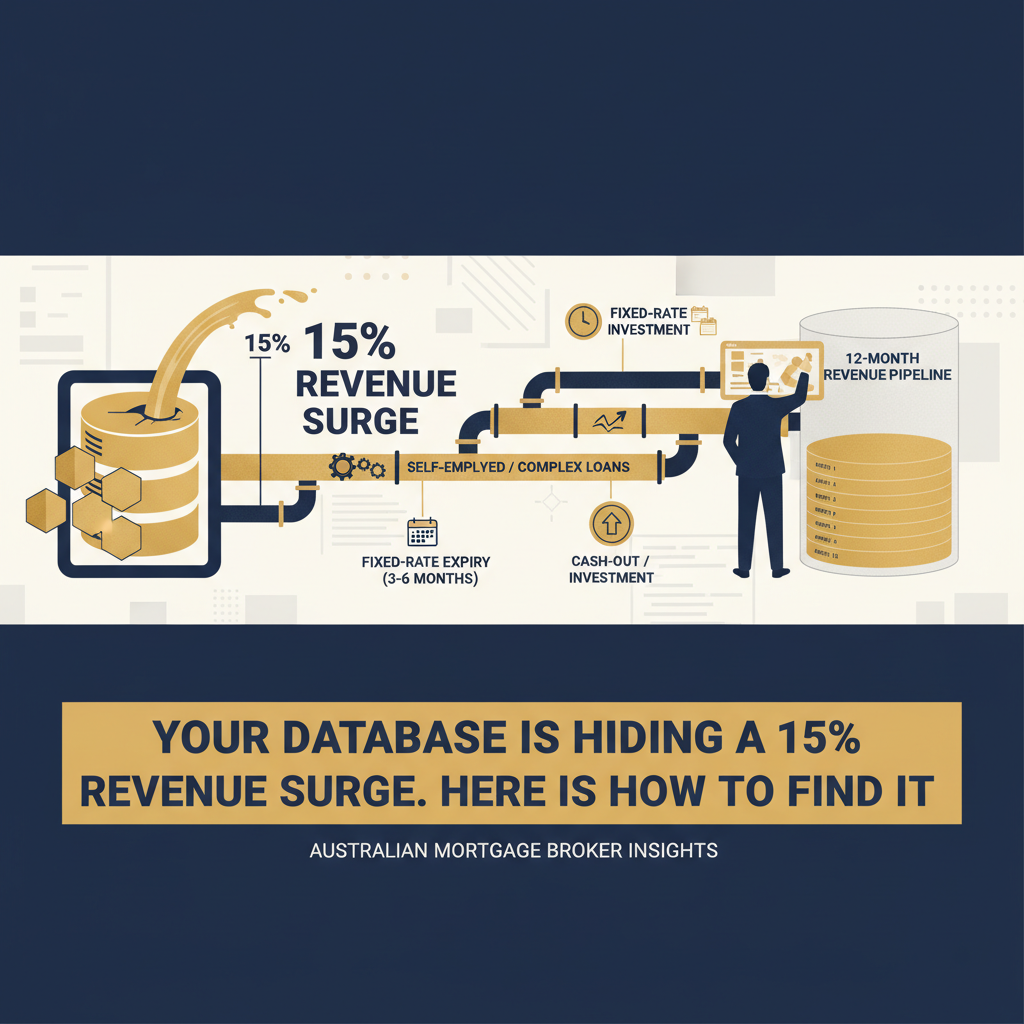
Refinancing activity in Australia grew by 15.1% year-on-year according to the latest ABS lending data.1 Brokers can leverage this momentum by auditing their existing database to target fixed-rate expiries and high-equity clients before they look elsewhere. Most of this revenue is already sitting in your CRM; it just requires a structured outreach sequence to activate it.
The high cost of passive retention
Many brokers assume a silent client is a happy client. This logic is a liability in a high-rate environment. When the market moves, your database becomes a hunting ground for major banks offering five-figure sign-on bonuses or aggressive introductory variable rates. If you are not the one initiating the review, you are effectively waiting for a discharge notice to arrive in your inbox.
A typical $50 million loan book contains roughly 80 to 100 clients. If 15% of those borrowers are currently overpaying the loyalty tax, that is a $7.5 million refinancing pipeline sitting dormant. On a $600,000 loan, the difference between a 7.2% rate and a 6.4% rate is roughly $4,800 in annual interest. Most borrowers will move for half that amount if the process is frictionless. You need to be the one showing them that math before a competitor does.
Segmenting for maximum strike rate
Broadcasting a generic newsletter to 500 people is a waste of time. High-volume brokers win by categorising their database into three distinct buckets. The first bucket consists of fixed-rate expiries due in the next 90 days. These are the highest priority. Many of these clients are moving from rates under 2.5% to something north of 6.5%. The second bucket is the equity-rich segment. These are clients with LVRs under 70% who haven't had a rate review in 18 months. They are the prime candidates for Lenders looking for low-risk, high-quality residential security.
Navigating the APRA buffer myth
The conventional move when a client's rate is too high is to run a quick serviceability test. This is where most brokers give up. The current 3% APRA serviceability buffer is a significant hurdle.2 On a single $120,000 income, the buffer alone can wipe roughly $40,000 off a client's borrowing capacity compared to three years ago. This creates a trap where the borrower is stuck with their current lender because they cannot technically qualify elsewhere.
Some lenders now offer a 1% serviceability buffer for like-for-like refinances.3 This is a massive policy shift. It applies provided the client has a clean repayment history for the last 12 months. This policy pivot is specifically designed to help mortgage prisoners escape high variable rates. If you are only testing deals at the standard 3% buffer, you are leaving half your pipeline on the table. Identify these trapped clients and look for lenders with specific refinance exceptions.
Building the 12-month outreach machine

Turning a surge into a pipeline requires a calendar. Block out two hours every Tuesday morning for database reviews. Use a simple heuristic; filter by interest rate first; then LVR; then income type. Start with anyone paying above 6.8% with an LVR under 80%. These are your easiest wins.
Your communication should be short. Send a two-sentence email or SMS. Tell them you noticed their current rate is roughly 0.5% above the current market average for their LVR. On a $750,000 loan, that 50 basis point reduction saves roughly $3,750 in annual interest. Ask if they want you to run the numbers. Most will say yes. By the time you finish the top of the list, the next batch of fixed-rate expiries will be 90 days out. This creates a self-sustaining cycle of settlements without the need for expensive new lead generation.
If you are working scenarios like this and tired of the document chase, see how the Halo team handles the operational layer at halofortune.com.au. We track lender policy changes so you can stay focused on the client conversation.
Filter your database by interest rate today and identify your top ten high-rate clients for a phone call tomorrow morning.
FAQs
Q: How can I identify which clients in my database are most likely to refinance?
Look for clients with fixed-rate loans expiring within 6 months, those with high LVRs who could benefit from equity growth, or self-employed borrowers with improved financials. Use CRM filters and loan expiry reports.
Q: What's the best way to approach self-employed clients about refinancing?
Personalize your outreach by referencing their specific business situation. Highlight how current rates can reduce their loan costs or free up cash flow for reinvestment. Offer a preliminary review of their latest tax returns and financial statements.
Q: How do I automate refinancing outreach without losing the personal touch?
Use CRM automation for initial emails and reminders, but schedule personal calls for high-value leads. Segment your list so complex cases (e.g., alt-doc) get personalized attention. A hybrid approach works best.
Q: What metrics should I track to measure pipeline success?
Track outreach response rate, number of appointments set, conversion rate to application, and average loan size. Also monitor client satisfaction and referral rates to gauge long-term pipeline health.
Q: Is now a good time to focus on refinancing given potential rate changes?
Yes, with a 15% surge and many borrowers still on higher rates, there is strong demand. Even if RBA holds rates, competitive pressure from lenders creates opportunities. However, stay informed about policy changes to advise accurately.
If you're running scenarios like this and the document chase is eating your week, the Halo Fortune MM team handles the operational layer — Halo Flex covers self-employed alt-doc and low-deposit deals where the majors decline; Halo Chat (broker-only RAG, built by Halo Fortune) returns cited lender-policy answers in under 30 seconds.
👉 Apply for Halo Fortune broker access — free, 5-minute submission →
Related reading
- May 2026 RBA Rate Hike: Serviceability, Self-Employed Clients, and the Refinance Cliff
- Proactive BID: Why ASIC is moving beyond the audit checklist in 2026
- Loan products
Sources
Footnotes
-
https://thebrokertimes.com.au/the-refinancing-outreach-machine-building-a-12-month-revenue-pipeline-from-your-existing-database/ , The Refinancing Outreach Machine: Building a 12-Month Revenue Pipeline From Your Existing Database ↩
-
Australian Prudential Regulation Authority (APRA), "APRA reinforces expectations on residential mortgage lending standards," Media Release 2023. ↩
-
Australian Bureau of Statistics (ABS), "Lending Indicators, Australia," Refinancing Statistics 2024. ↩
Next step
Run your own scenario through Halo
30-second pre-check — product match, doc checklist, approval odds. No login needed.
Run a scenario →